Artificial Intelligence
AI Goes Physical : How robotics could augment Agritech in Kenya
·6 min read
Breaking the Digital Screen
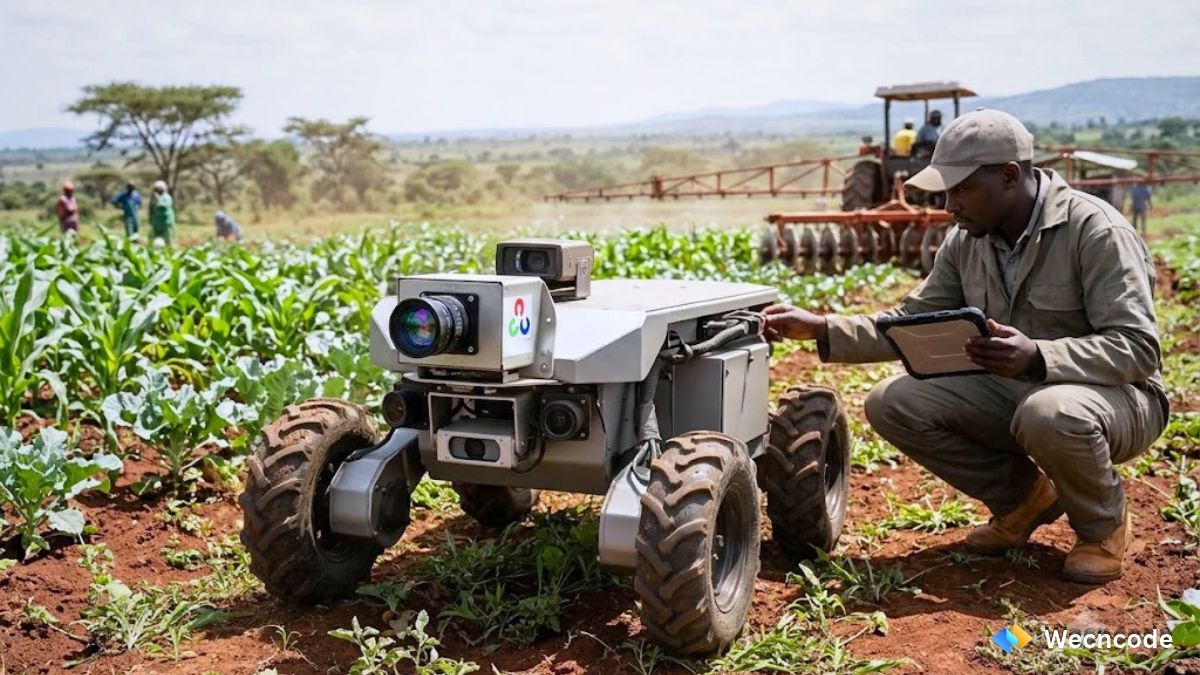
For decades, the software engineering playbook has been purely digital. Developers wrote code for stateless cloud environments, scaled databases, and optimized frontend button clicks. However, a massive paradigm shift is occurring. Artificial Intelligence is breaking free from web browsers and entering physical reality. This is the era of embodied AI—where code must actively interact with gravity, physical friction, and unpredictable environments. Nowhere is this physical revolution more urgent or high-stakes than in African agriculture. While developed nations rely heavily on advanced farm mechanization, Africa’s economic backbone still depends on intensive manual labor. From weeding and spraying to harvesting, smallholders manage large tracts of land manually. Bringing AI into the fields via drone-controlled spraying, real-time weed detection, and automated pest control is no longer a luxury; it is a systemic necessity. However, building software for a physical machine in a tropical agricultural environment requires a massive technical and mental shift for developers.
The Twin Constraints of Edge Ag-Tech
When your code drives a physical asset through an open field, a bug doesn't just trigger an error log, it can crash an expensive drone or ruin an entire season's harvest.
Software engineers must program for two uncompromising realities:
A. The Localized Data Gap (Tropical Ecology vs. Monoculture)
Most open-source computer vision datasets are trained on flat, heavily manicured monoculture farms in Western regions. An AI trained on European aphids or Iowa cornfields will fail entirely when deployed in an African tropical ecosystem. African farms face unique pest profiles (such as the Fall Armyworm) and distinct farming styles like intercropping, where multiple crops grow alongside each other. An automated weed detector must be trained on localized, indigenous datasets to accurately distinguish a weed from a companion crop amid complex vegetation.
B. Rugged Geographies & Edge Architecture
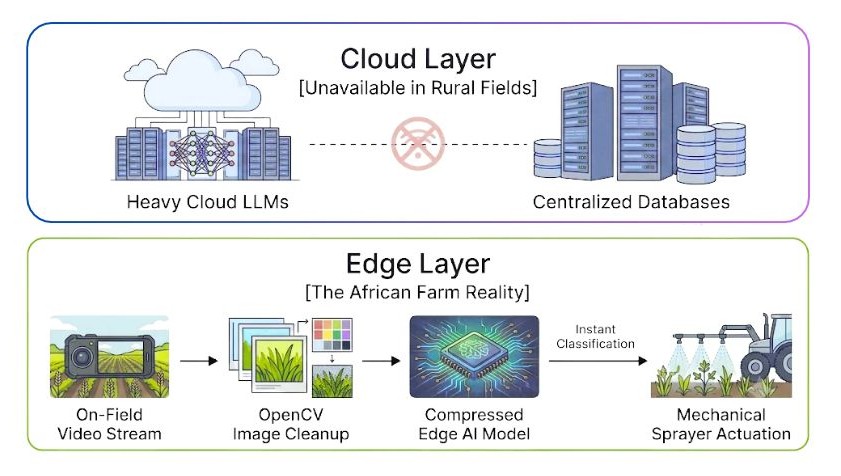
A software engineer cannot assume a reliable 5G cloud connection in a rural field. The environment is defined by rugged terrains, high heat, dust, and continuous vibrations. This mandates an offline-first approach. The machine learning models must be lightweight enough to execute entirely on low-power edge compute units mounted directly to the chassis, featuring rigorous fail-safe logic to halt operations if hardware sensors become obstructed by dust.
The Localized Ag-Tech Stack
To bridge the gap between digital logic and physical agricultural automation, engineers must master a specialized, multi-layered stack:
● Model Prototyping (Python & PyTorch): Python remains the core tool for training computer vision models on regional datasets. However, because raw models are too compute-heavy for small batteries, developers utilize compression tools like ONNX or TensorRT to optimize weights.
● Edge Processing (C++ & OpenCV): On the machine itself (e.g., an NVIDIA Jetson or Raspberry Pi), C++ handles low-latency execution. Combined with OpenCV, it allows the robot to filter out intense tropical glare, crop frame dimensions, and calculate geometric boundaries in real time.
Here is the Python-based OpenCV mock code demonstrating how a lightweight edge device (like a Raspberry Pi or Jetson Nano) dynamically captures a video feed from a drone or robotic tractor camera, strips away intense tropical sunlight glare, filters environmental noise, and masks pixels to isolate green vegetation (weeds or crops) in real time.
import cv2
import numpy as np

def process_agricultural_frame(frame):
    """
    Simulates real-time edge processing for localized weed/crop isolation.
    Optimized for low-latency hardware on rugged tropical terrains.
    """
    # 1. Mitigate intense tropical glare by converting from BGR to HSV color space.
    # HSV is vastly superior for outdoor computer vision as it separates lighting from color
    hsv = cv2.cvtColor(frame, cv2.COLOR_BGR2HSV)

    # 2. Apply a Gaussian Blur to eliminate high-frequency noise caused by dust/vibrations
    blurred_frame = cv2.GaussianBlur(hsv, (5, 5), 0)

    # 3. Define the precise threshold range for 'Tropical Green' vegetation
    # Lower and Upper bounds for chlorophyll detection under daylight conditions
    lower_green = np.array([35, 40, 40])
    upper_green = np.array([85, 255, 255])

    # 4. Generate a binary mask where green vegetation = 255 (White), soil/terrain = 0 (Black)
    vegetation_mask = cv2.inRange(blurred_frame, lower_green, upper_green)

    # 5. Extract structural boundaries using Canny Edge Detection
    # This maps the contours of leaves to differentiate crop rows from intrusive weeds
    edges = cv2.Canny(vegetation_mask, 100, 200)

    return vegetation_mask, edges


# Mocking the physical edge device camera stream pipeline
# In production, this loop executes at 30+ FPS directly on the hardware chassis
cap = cv2.VideoCapture(0)

while cap.isOpened():
    ret, frame = cap.read()
    if not ret:
        print("[FAILSAFE] Camera feed lost or lens obstructed by dust. Halting actuator valves.")
        break

    # Process the frame on the local edge CPU/GPU
    mask, crop_contours = process_agricultural_frame(frame)

    # Logic pipeline steps offloaded to ROS 2 middleware:
    # If crop_contours density exceeds target threshold outside normal crop row spatial arrays:
    #     trigger_actuator_nozzle(valve_id=4, dynamic_spray_duration=120)

    # Break out if human override signal is detected
    if cv2.waitKey(1) & 0xFF == ord('q'):
        break

cap.release()
cv2.destroyAllWindows()
● Hardware Actuation (ROS 2): To translate a software classification ("Pest Detected") into a physical movement ("Open Spray Valve"), developers use the Robot Operating System (ROS 2) middleware to orchestrate sensor-to-actuator communication safely.
Overcoming the Affordability Barrier: Farming-as-a-Service (FaaS)
A major critique of agricultural robotics is cost. Can a smallholder farmer managing two acres afford a customized autonomous drone or an AI-powered weeding tractor?
Out-of-pocket ownership is commercially unviable.
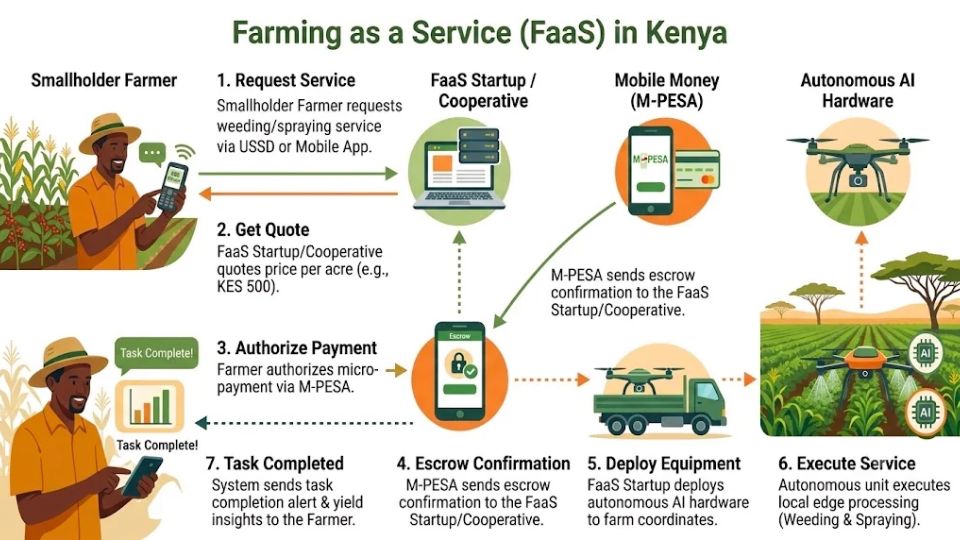
The solution lies in a paradigm shift from hardware ownership to Farming-as-a-Service (FaaS).
By decoupling the technology from hardware ownership, the financial dynamic completely changes:
1. The "Uber for Tractors" Model: Ag-tech startups or local community cooperatives pool capital to buy the physical AI hardware. Smallholders simply request services on-demand via simple USSD codes or mobile apps.
2. Micro-Transactions via Mobile Money: Farmers pay an accessible, predictable fee per acre using existing local networks like M-PESA.
3. Low-Cost Open Hardware Integration: By prioritizing open-source middleware (ROS 2) and consumer-grade edge modules (like standard microcontrollers and modular camera links), the manufacturing costs of these autonomous systems drop dramatically compared to proprietary Western counterparts.
The Economic & Livelihood ROI
The ultimate goal of bringing AI out of the tech lab and into the fields is human impact. Deploying accessible, localized models directly to smallholders transforms the agricultural lifecycle. By automating grueling, time-consuming operations like weeding and manual spraying, physical AI increases operational efficiency and crop yields.
More importantly, it liberates the farmer's time. Instead of being confined to manual field work, agriculturalists gain the bandwidth to explore new consumer markets, manage logistics, and pivot toward value addition, such as processing raw yields rather than selling them at a loss. The economic surplus generated directly uplifts communities, paving the way for sustainable development and better education for the next generation.
For the modern software engineer, writing code for the physical world is the ultimate frontier where digital lines of code yield tangible, life-changing results.
Share this blog
Written by Frankline Kimtai
Frankline is a developer specializing in software, data, and IT systems, with experience across industry and research environments. He shares his insights on Medium, Hashnode, and LinkedIn, focused on translating complex technology into real world application and is a tech writer at Wecncode.
More from Frankline Kimtai