Artificial Intelligence
Software Development Life Cycle in the AI Age

·11 min read
Have you been thinking about the software development Life Cycle and its methodologies after the emergence of AI and its application in Software Development/Engineering?
This article will help you clear the doubts and provide answers. However, note that the approaches mentioned here are not the standardized approach to software development in the current times. For better understanding we will start by looking at the Software Development Life Cycle.
What is the Software Development Life Cycle?
Software development life cycle also referred to as application development life cycle or Systems development life cycle is the methodology followed in order to plan, design, implement, test and maintain software. These phases progress from inception to retirement/decommissioning (when the software/system/application reaches end-of-life). SDLC corresponds to the life cycle of a living organism from its birth to its death. It varies by software in the same way a living organism's path differs through its life. Software development is often an iterative process, that is, developers will create, test and deploy early versions of software or systems quickly and then iterate on their initial implementation and setup to improve the quality, performance and add more features.
SDLC allows developers to develop high quality, well-tested software efficiently and at a low cost. The following are the phases which are somewhat ordered by the sequence of development though as said initially they can be iterative and also overlapping.
a) Conceptualization:During this phase the options and priorities are considered. A feasibility study, assessment of the practicality of a project or system, can determine whether the development effort is worthwhile via activities such as understanding user needs, cost estimation, benefit analysis and resource analysis.
b) Requirements analysis/gathering: This phase involves understanding the problem and finding out what is needed. This often entails engaging and speaking to users and understanding their pain points and learning what performance requirements need to be met.
c) Design: During the design phase a solution is planned. This phase is informed by the requirements of the system, the design must satisfy all the requirements. Software developers in this phase investigate how to best implement their solution taking into account dependencies, performance, requirements and existing system architecture if there is any. The output of this phase is often a document which clearly outlines architecture decisions and implementation details of the solution which is often presented to stakeholders (if involved) for review. This process can occur several times until there is agreement on the proposed solution.
d) Implementation/Construction: During implementation, the software is realized. Based on the proposed design, hardware (if need be) and software components are created and integrated. This phase is what we often think of as the software engineer's/developer's work, writing code. Developer(s) responsible writes new or updates existing code to meet the design and requirements laid out.
e) Testing & Integration/acceptance: This phase often involves executing the system with test cases that are derived from the specification of the real data to be processed by the system. There are several testing methods namely - unit testing, module testing, sub-system testing, system testing and acceptance testing. The whole point of this phase is to ensure that the system will meet customer expectations (requirements).
f) Deployment: Deployment involves the logistics of delivery to the customer and it may include training users to use the system if there is a need. Deployment refers to pushing code from a developer's local environment to the production environment, where users will interact with the system.
g) Maintenance/operationalization: During this phase development shifts from building new features to fixing and improving, although this phase does include customer support for resolving user issues and recording suggestions for improvement. Since software development is an iterative process, a developer's work is never really complete. They have to continuously monitor their services in production to ensure there are no hiccups.
h) Retirement/Decommission: Decommission is when the system/software is removed from use i.e. when it reaches end-of-life.
SDLC has models and methodologies which implement the core phases we have looked at namely:
Agile
Waterfall
Iterative
Spring
V-model
Incremental
DevOps
What is AI age?
The Age of AI also referred to as the Intelligence Age is a historical era characterized by the transition from the Digital Age to a period where machine learning intelligence becomes foundational for decision-making, creativity and productivity. This era is defined by the widespread adoption of generative AI, large language models(LLMs) and AI technologies that integrate into global systems similar to how electricity or the internet did in previous decades. The era is marked by AI-driven automation in knowledge work, healthcare, and education, with projections suggesting AI could add trillions to the economy by 2030.
Unlike earlier AI winters, the current period is described as an AI Spring due to the availability of big data, cloud computing and neural networks that allow systems to learn from vast datasets rather than relying on static programmed rules. How has AI emergence influenced the state of software development life cycle process? For quite a long time developers have arranged software development around the SDLC phases using different frameworks such as agile or waterfall where requirements lead into design, design leads to implementation, implementation leads to testing, testing leads to deployment and so on.
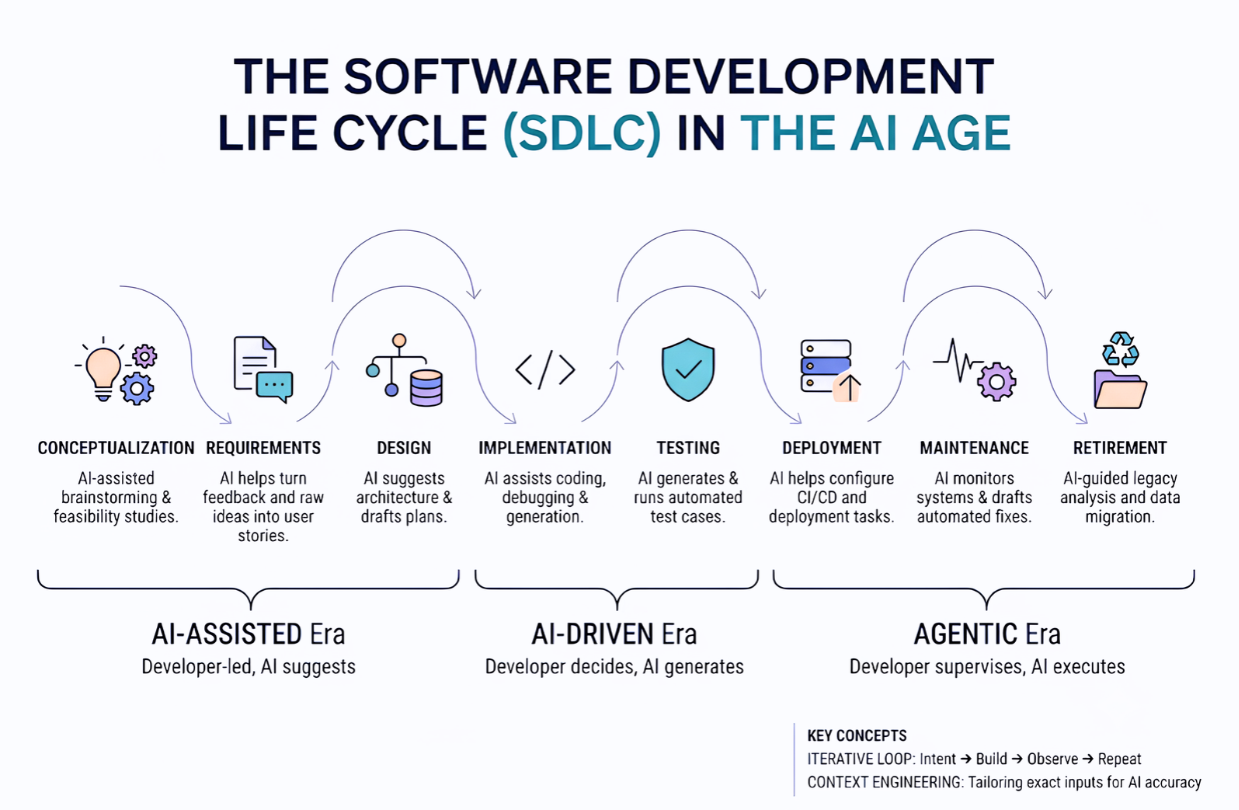
The SDLC has evolved incrementally over time for decades. For example, agile was a response to waterfall's rigidity and DevOps later extended Agile by joining development and operations. We are now entering a new era, the AI-first SDLC, where multi-agent AI systems are beginning to take on many roles. AI is changing the SDLC mental model by making it concurrent rather than sequential. There have been three different AI eras in development.
AI-assisted (2020-2023)
AI-driven (2023-2025)
Agentic (2025+)
Note: The timing provided is not the exact timing but an estimate.
Agent Development Life Cycle (ADLC)
In the AI-assisted era, the developer was the primary creator while the AI simply auto-completed and provided suggestions. In the AI-driven era, the developer's role has been to provide validation and decision-making while the AI generates code, plans and performs tests.
In the Agentic era, the developer is responsible for supervising and architecting while the AI agent performs autonomous multi-step execution. If you look at the timing, we are currently in the Agentic Age, which brings us to the term Agent Development Life Cycle. It refers to the approach of designing, developing, testing, deploying and monitoring AI agents An AI agent is a piece of software that uses large language models to achieve a specific goal on behalf of a user. Core capabilities include Autonomous operation (Independent), Reasoning and planning , Continuous learning and Environmental awareness
ADLC introduces considerations such as:
Agent reasoning and decision-making
Context and memory management
Multi-agent collaboration
Tool and API integration
Behavior evaluation
Safety and human supervision
Continuous monitoring
Apart from ADLC there's another life cycle: Intent, Build, Observe, Repeat (in simple terms, it's a developer or engineer with intent and an agent that executes).
Note: The quality of what a developer builds is largely attributed to the quality of context they give the agent or AI development tools that is if they are developing using them, often referred to as context engineering.
Context Engineering
Context engineering refers to the practice of designing, structuring, and optimizing the full set of tokens, data, and tools provided to a large language Model or AI agent to ensure accurate and reliable inputs. What each phase of the SDLC looks like today:
Conceptualization: Remember this is the phase where we consider options and priorities. AI helps in brainstorming ideas and checking if they're worth building and listing the risks and benefits. This was the phase where the feasibility study was conducted, which could days or even weeks but right now it can often take hours, however, humans still decide what is worth building.
Requirements Gathering: At this phase the main goal is to understand the problem and find out what is needed. AI can summarize user interviews and find common pain points in feedback and it can also turn messy notes into clear requirements or user stories. Teams(developers) do ,however, need to talk to real users to understand their frustration since AI cannot understand it the way you can.
Design Solution Planning: AI can suggest architectures, draw diagrams, propose structures and write drafts of the design document. It can also explain the trade-offs between options. For example you're not sure whether to implement the solution using Python programming language or Rust. Here, developers reviews and choose and then stakeholders approve the final plan.
Implementation: Where the software is realized. This is where AI has impacted the most. Tools like Claude Code, GitHub Copilot and Cursor write code, fix bugs, refactor and explain unfamiliar code. Many developers now spend more time describing what they want and reviewing the output than typing every line. Reviewing is probably the most essential since AI code can look right and still be wrong or insecure.
Testing: AI can generate unit tests, suggest edge cases you missed, and review code for bugs and security holes. Some tools can even run the app and test it like a user would. As a developer you however, define what correct means and sign off on acceptance testing.
Deployment: AI helps write deployment scripts and CI/CD pipelines, set up cloud configuration and troubleshoot failed deployments. It can also draft user guides and training material. Developers approve what goes to production.
Maintenance: AI monitors systems, detects unusual behavior, reads logs to find the cause of errors and sorts user support tickets. It can also suggest fixes, or even open a fix for review automatically.
Retirement/Decommission: AI can make the retiring of a system smoother. It can read old code that has little documentation and explain what it does, so the team knows which features and data must be kept. It can also help move data and code to the new system, find other services that still depend on the old one and write shutdown notices and migration guides for users. It can even analyze usage and maintenance costs to show when a system is no longer worth keeping.
The phases are the same, but they're faster and overlap more. Teams and developers now loop between them quickly instead of moving in a strict line. Risks and implications of Using AI in the SDLC AI can make software development faster, but it comes with risks that teams need to manage.
The future ahead with the new Agentic lifecycles
One of the biggest risks is wrong or low-quality output; AI-written code can look correct and still contain bugs, so it must always be reviewed and tested. It can also introduce security problems, such as insecure code, weak settings, or outdated libraries. Some AI tools may suggest code that copies licensed work, which raises legal and copyright concerns.
Privacy is another issue because pasting company code, customer data, or secrets into AI may expose them. Teams can also become too dependent on AI, so developers, especially beginners may stop learning the basics and struggle to understand or fix the code they ship. AI can also be biased or make unfair assumptions when it summarizes user feedback or suggests requirements and it can hallucinate facts or features that do not exist.
Lastly, when something goes wrong, it is unclear who is responsible. Accountability must stay with humans. The implication is that AI should be treated as a helpful assistant, not as a replacement for judgement. Teams and developers need clear rules for what data can be shared, human review at every phase, strong testing and security checks and continued investment in developer skills. In conclusion, the phases of the SDLC remain the same, but AI has made the process faster, more concurrent and more dependent on human oversight.
Developers are moving from writing every line of code to directing, reviewing and deciding, which makes skills like context engineering, testing and critical review more important. It is worth noting that the frameworks described here are not a standardized approach to software development at present.
Share this blog
Written by Kelvin Kipchumba
Kelvin is a full stack engineer and brand identity designer. He leads with the belief that leadership should make people and communities better, and serves as the Local Committee Vice President for Outgoing Global Exchange at AIESEC and mentor at GDG-Chuka and Wecncode.
More from Kelvin Kipchumba