Artificial Intelligence
The Data Center Dilemma: The Physical Footprint of the AI Boom

·7 min read
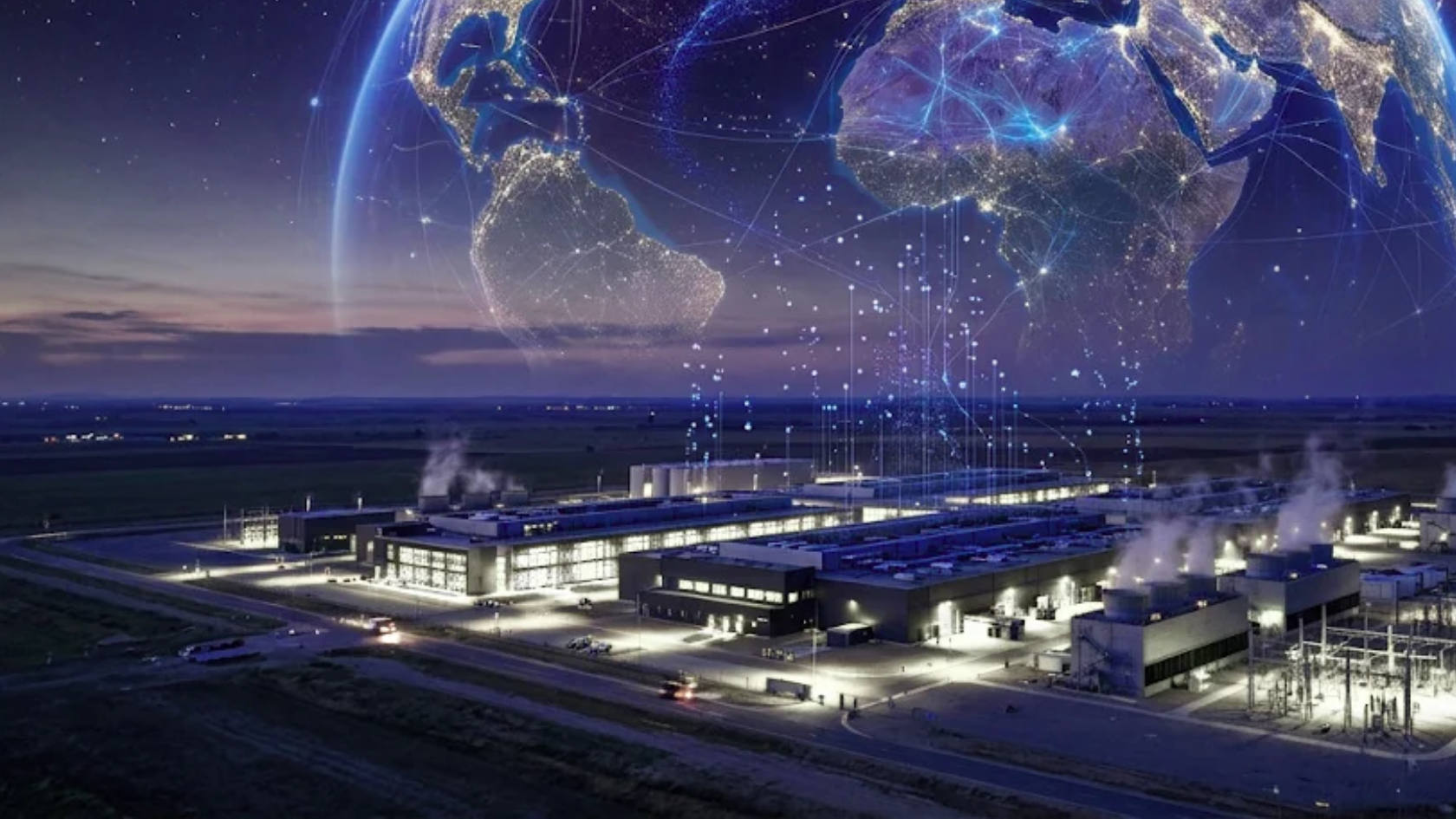
The AI on your phone feels weightless, but behind every answer is a building full of chips, a heavy power connection, and a race that now involves some of the biggest names in technology and politics.
Open any AI app and it looks like every other app on your phone, because you type, it answers, and nothing in your hand gets warm.
So it is fair to ask why NVIDIA, OpenAI, Anthropic and even the world governments keep talking about gigawatts, billion-dollar buildings and national strategy when this is supposedly just software. The answer starts decades before ChatGPT or Claude existed.
Fact 1 - It started as a military experiment
The internet we use today began as ARPANET, a network funded by the US Defense Department's research agency in the late 1960s so that computers in different places could share information reliably. On October 29, 1969, researchers at UCLA tried to send a message to a computer at the Stanford Research Institute, and the system crashed after the first two letters, which means the network that eventually connected the world began with a failed text message.
The idea that made it work was packet switching, where a message is broken into small packets that travel along whatever routes are available and get reassembled at the other end. That is still how it works today, so when you send a message from your phone in Africa to someone in Europe, it is split into packets, travels through undersea cables along the coast and arrives in a fraction of a second.
Once moving information was solved, the next problem was finding it, and that is where Google came in. It began as a Stanford research project in the late 1990s and built its business by crawling the web, indexing it and retrieving the most relevant pages almost instantly, which made the internet usable but also required data centers to store and serve all of that information.
Fact 2 - A language model is a different kind of machine
Google Search mostly retrieves, meaning it finds something that already exists and points you to it, while a large language model generates, building its answer one piece at a time by running your prompt through billions of adjustable values called parameters. Every word it produces is the result of an enormous number of calculations, and that is why the work is so much heavier than looking something up.
Training one of these models is heavier still, because it means processing vast amounts of text and adjusting those parameters over and over, usually across thousands of specialized chips running together for weeks or months. After that comes the part people tend to forget, which is that the model has to run again every time someone sends a prompt, and since your phone is only the window, the real computing happens in a data center that could be on another continent. An app on your phone mostly uses your phone, but an AI assistant uses a building.
Fact 3 - NVIDIA sits at the center of the AI times
Graphics processing units, or GPUs, were originally designed to render images, which means doing many simple calculations at the same time, and that strength turned out to fit the math behind neural networks almost perfectly. NVIDIA's GPUs became widely used for training and running AI models, so the company now sits at the center of the hardware layer, and because chips like these draw serious power and give off serious heat, packing thousands of them together creates demands for electricity, cooling and networking that ordinary computing never had.
Fact 4 - The race for intelligence is a race for infrastructure
OpenAI made this visible in January 2025 when it announced the Stargate Project, a plan to invest up to $500 billion over four years in US AI infrastructure, which is a stated plan and not proof that the money has been spent. Anthropic shows the same pressure from another direction, since in October 2025 it announced an expansion with Google involving up to one million TPUs with well over a gigawatt of capacity expected in 2026, and in April 2026 it announced a separate agreement with Amazon for up to five gigawatts of computing capacity.
These are announced commitments and not measurements of electricity already used, but they show where the industry is heading, which is that access to computing capacity has become a strategic priority.
Fact 5 - Global political arena shaping the progress of AI
When computing needs power plants and transmission lines, it stops being only a technology story, and on July 23, 2025, President Trump signed an executive order to speed up federal permitting for data centers and related infrastructure, including high-voltage transmission lines, which signals that AI infrastructure is now treated as a matter of national competitiveness. The International Energy Agency's 2025 Energy and AI report looks at the same pressure from the energy side and notes that data centers are becoming a bigger part of electricity planning, although how much demand grows depends on adoption, efficiency and how fast infrastructure gets built.
Governments tend to see economic leadership and security in all this, while local communities see something closer to home, with construction, jobs and tax revenue on one side and pressure on power bills, land and local resources on the other.
Fact 6 - Water resource is the most precious
Electricity is the biggest piece of the footprint, but cooling and power generation bring water into it as well. Lawrence Berkeley National Laboratory's 2024 report estimated that US data centers directly consumed about 17 billion gallons of water in 2023 and nearly 211 billion gallons indirectly through the electricity they used. Those figures cover US data centers as a whole and not AI alone, and the indirect number reflects water used in power generation, so they are useful for showing that the footprint reaches well beyond the building and not for blaming any single AI service.
What we can take-away from this happenings as builders and innovators!
Most of us enter AI through the visible layer of models, apps and demos, but a lot of the real engineering lives underneath, where efficient software, smaller models where they are enough, better scheduling and smarter hardware choices all change how much a system costs to run. Efficiency does not automatically mean lower total use if demand grows faster, but it is where a developer can make a real difference, and for students in Africa it is a reminder that building a frontier model is not the only way into this industry, since data infrastructure, efficient deployment and systems engineering are all skills the AI boom depends on.
The AI on your phone traces back to a failed two-letter message in 1969, through the internet and search, to models that need buildings full of chips to answer a single question, and NVIDIA, OpenAI, Anthropic and the world governments are all responding to the same fact, which is that intelligence at this scale has a physical cost.
We do not know whether the pursuit of superintelligence will deliver what its advocates promise, but we can already look at what is being built in its name and ask whether it is being built responsibly, because if we want to understand where AI is going, we need to understand what it takes to keep it running.
Share this blog
Written by Wosu-Ezi Blossom
Blossom is a Computer Science student and tech writer at Wecncode passionate about making complex technical concepts clear, practical, and accessible. Her interests span technology, AI, data, and the ways people interact with digital products.
More from Wosu-Ezi Blossom