Artificial Intelligence
The Trillion-Dollar Bet - Chasing the Elusive AI ROI

·3 min read

Artificial intelligence has become one of the biggest bets in the technology industry. From chatbots that write code to systems that analyse data in seconds, AI promises to change how businesses operate. Companies are investing billions in this promise, but one question remains: when does all this spending actually pay off?
The excitement is understandable. No business wants to be left behind as competitors adopt technology that could make them faster and more efficient. Yet investing in AI and making money from it are two very different things.
The Price of Staying Ahead
Building AI is expensive. Behind every seemingly simple AI response are powerful processors, data centres, electricity and teams of people developing and maintaining the technology. For companies building large AI models, these costs can be enormous. And the spending does not stop once a product is launched. Models need to be improved, infrastructure maintained and security strengthened. Meanwhile, the technology evolves so quickly that today's competitive advantage could become tomorrow's standard feature.
For businesses, the pressure to invest is real. However, spending money to keep up with competitors does not automatically mean that an investment will generate a worthwhile return.
Where Is the Return on Investment?
Return on investment (ROI) is a simple idea: does the value gained justify the money spent? For AI, the answer is not always straightforward. A company let’s say company X, might introduce an AI tool that helps employees complete tasks faster, but the time saved does not necessarily translate into increased revenue. Another company might spend months integrating AI into its operations before seeing meaningful benefits.
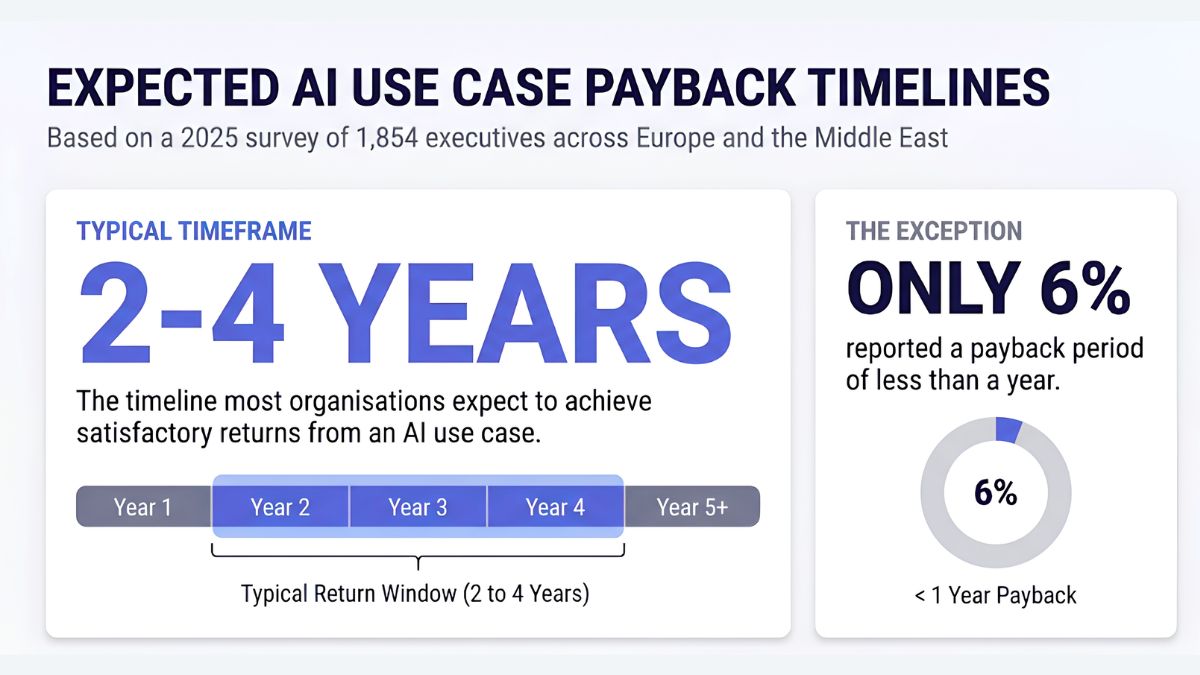
Deloitte's 2025 research, based on a survey of 1,854 executives across Europe and the Middle East, found that organisations typically expected two to four years to achieve satisfactory returns from an AI use case. Only 6% reported a payback period of less than a year.
The challenge is not necessarily that AI fails to deliver value. It is that value can be difficult to measure, especially when the benefits involve improved decision-making, better customer experiences or work that employees can complete more efficiently.
Beyond the Hype
The companies most likely to benefit from AI may not be those spending the most. They may be the ones asking better questions before investing.
What problem are we trying to solve? Will AI solve it better than existing tools? How will we measure success? And are employees prepared to use it effectively?
These questions matter because introducing AI often requires more than buying software. Businesses may need better data, employee training and changes to existing workflows. Without these foundations, even an impressive AI system can struggle to deliver meaningful results.
The trillion-dollar AI bet is therefore not simply about who builds the most powerful technology. It is also about who can turn that technology into something useful, sustainable and profitable.
The Real Test
It's true that AI's potential is difficult to ignore, but potential alone cannot justify endless investment. As the industry matures, businesses and investors will increasingly need evidence that the money being spent is creating real value.
The race to develop AI may capture the headlines, but the race to make it pay is just as important.
In the end, the biggest AI success story may not be the company that spends the most. It may be the one that figures out how to get the most out of every dollar spent.
Share this blog
Written by Chelsea Valerie
Chelsea is an Electrical and Telecommunications Engineering student passionate about technology and innovation. She enjoys exploring emerging tech trends and turning technical concepts into clear, engaging, and relatable stories.
More from Chelsea Valerie