Cybersecurity
The $2 Million Roblox Fumble: How One Dev Cooked Vercel's Entire AI Security

·5 min read
If you thought major cyberattacks were pulled off by shadowy, elite hackers typing green code in a dark basement, you’re living in a movie. The reality? Way funnier and honestly, super embarrassing.
The $2 Million Roblox Fumble: How One Dev Cooked Vercel’s Entire AI Security
In April 2026, Vercel (the cloud giant basically carrying Next.js on its back) got breached. Customer environment variables were snatched, and the hacker group ShinyHunters slapped a $2 million ransom on the data. But the lore behind this breach is insane. It didn’t start with a zero-day exploit or a master heist.
It started because an engineer at an AI startup didn’t want to grind in Roblox. Here is the tea on the Vercel hack, why the internet is basically held together by digital duct tape, and what it actually means for the AI era.
The Timeline: How to Fumble the Bag in Three Steps
To understand why the cybersecurity world is collectively facepalming right now, we have to look at the timeline of how this actually went down:
Phase 1: The Roblox Side Quest (February 2026):
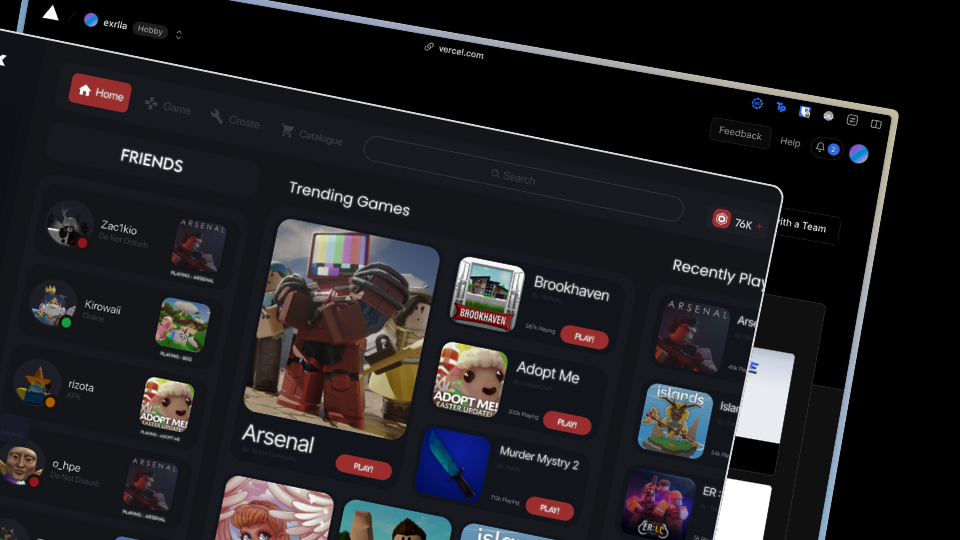
An employee at a small AI startup called Context.ai (opens in a new tab) got tired of grinding in Roblox like an NPC. They hit the web to download an “auto-farm” script. Huge L. The download was packed with Lumma Stealer, a nasty malware that speedruns stealing your data. It sat on their PC and quietly scraped every saved password, session cookie, and API key it could find, shipping it all straight to the dark web.
Phase 2: The “Blind Click” (Sometime Later):
Meanwhile, over at Vercel, an employee decides to test out Context.ai (opens in a new tab)’s new “AI Office Suite.” They sign in using their corporate Google account. You know that pop-up that asks for permissions? Yeah, they didn’t read it. They just hit “Allow All” on autopilot. By doing that, they basically handed this random AI startup the master keys to their enterprise workspace. No thoughts, just vibes.
Phase 3: The Pivot (April 2026):
Hackers realize the stolen Context.ai (opens in a new tab) credentials belong to a core engineer. They break into Context.ai (opens in a new tab), find that OAuth token granted by the Vercel employee, and literally just walk through Vercel’s front door. From there, they grabbed a bunch of non-sensitive environment variables and hit them with a $2 million ransom demand.
The “Smart” Ecosystem is Actually Cooked
There is a massive irony here. For the last two years, tech bros have been obsessed with slapping AI wrappers on everything. Everyone wants an AI agent that can read their emails and do their homework. But the Vercel breach exposes the fatal flaw: having a 200 IQ AI agent means literally nothing if your security is trash.
To make these AI tools work, they need your data. So, they ask for insane permissions through OAuth (those “Sign in with Google” screens).
The Vercel hack proves that every single time an employee grants one of these loosely-governed AI tools access to their workspace, they are creating a backdoor. The hackers didn’t need to break Vercel’s heavy-duty encryption. They just had to break into the smaller, sloppier AI startup that a Vercel employee had already given the keys to. This is what the industry calls a supply-chain attack, and it’s basically the digital equivalent of locking your mansion’s front door but leaving the doggy door wide open.
RIP to “Allow All”
If there’s one major takeaway for our generation — the generation that grew up blindly scrolling to the bottom of Terms & Conditions to click “Accept” — it’s that the blind click culture is officially dead.
Vercel is already doing massive damage control. They’ve forced password rotations and changed their systems so that new environment variables are marked “sensitive” by default. They are essentially operating under the assumption that human beings will continue to click “Allow” without reading, so they literally had to idiot-proof the system.
The TL;DR for the Future of AI
This event is going to permanently change how companies handle AI:
Trust > Tech:
The companies that survive the AI boom won’t necessarily be the ones with the smartest models. They will be the legacy companies (like Microsoft or Google) that already have secure walled gardens. Why risk giving your company’s data to a random AI startup when you can just use the AI built straight into the tools your IT department already locked down?
The Security Tax:
Cybersecurity platforms are about to secure the absolute bag. Companies are going to have to drop millions on identity management and security just to babysit all the AI tools their employees are trying to use.
The Infostealer Epidemic:
Malware like Lumma Stealer is cheap, highly effective, and everywhere. As long as people are downloading shady files — whether it’s pirated software, cracked games, or Roblox cheats — we are going to keep seeing these breaches
Bottom line: We built the most advanced cloud infrastructure in human history, and it got absolutely bodied because one guy didn’t want to grind for virtual currency in a kids’ game. Absolutely Wild!
Keep Hacking! 👽
Share this blog
Written by Lana Louphul
Lana is a Techpreneur, AI Safety Researcher and Data Scientist, dedicated to building platforms to make tech education accessible to all. She shares her industry insights as a tech writer at Wecncode.
More from Lana Louphul